
Strategies
5 Practical ways to keep your finances safer online
Kaspersky’s fresh data for Q2 2021 showed a 60% increase in mobile banking Trojan attacks blocked in the region versus same period last year.


Kaspersky reveals its Q2 2021 mobile threat report for Southeast Asia (SEA) where it has monitored a 60% uptick in the number of attacks using malicious mobile bankers detected and blocked in the region.
Mobile banking Trojans – or bankers – are used by cybercriminals to steal funds directly from mobile bank accounts. These malicious programs typically look like legitimate financial apps, but when a victim enters their security credentials to try to access their bank account, the attackers gain access to that private information.
Overall, since the beginning of 2021, Kaspersky products have foiled 708 incidents across six countries in SEA. This is already 50% of the total number of mobile bankers blocked in 2020 which was 1,408.
Indonesia and Vietnam logged the most number of incidents during the first half of the year. However, globally, the two countries are not among the top 10 countries affected by this threat. Vietnam is only 27th and Indonesia is 31st as of June this year.
The five countries with the most number of mobile banking Trojan detections in Q2 2021 are Russia, Japan, Turkey, Germany, and France.
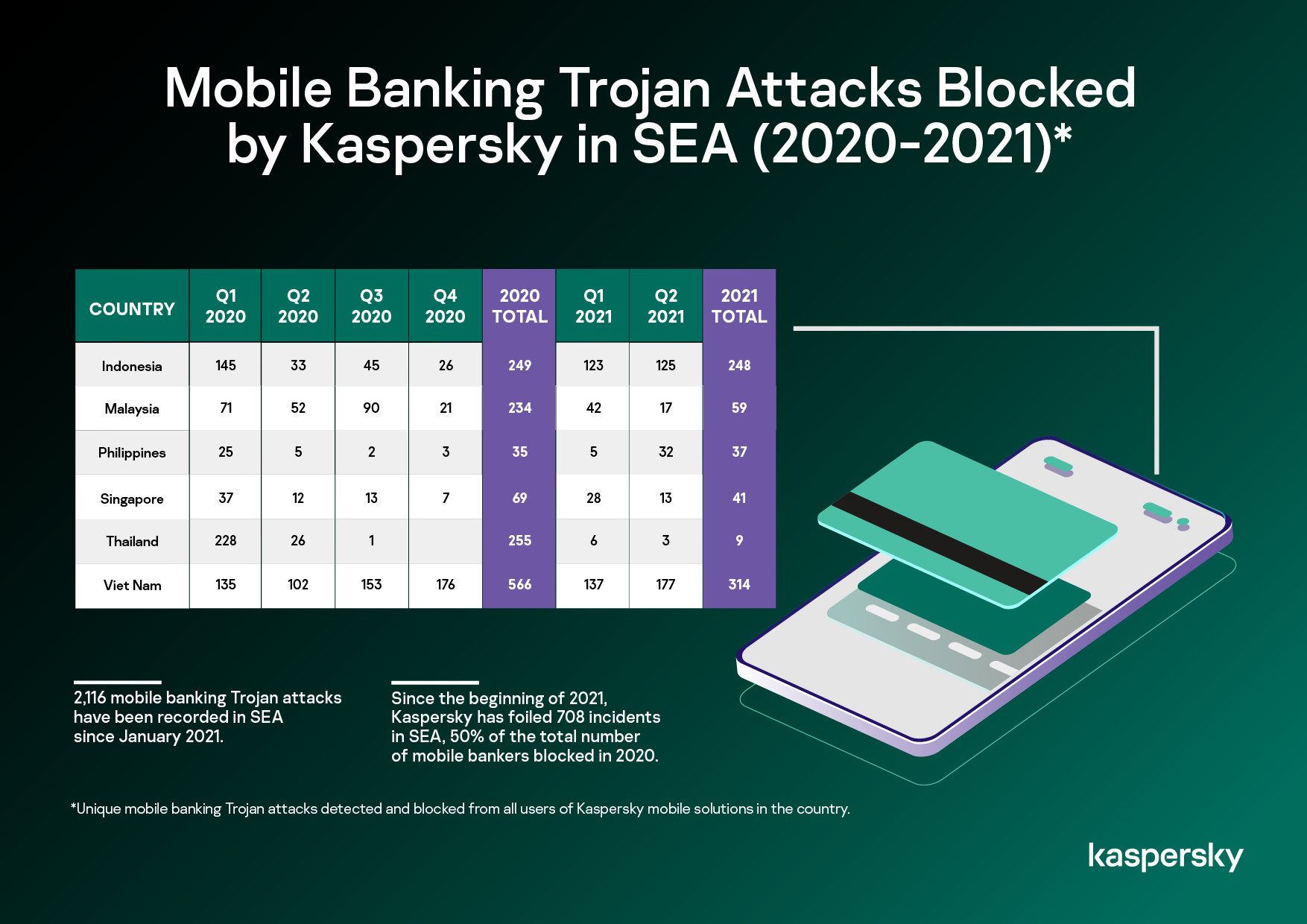
*Mobile banking Trojans attacks detected from users of Kaspersky mobile security solutions in the country
While the number of mobile banking Trojan attacks in SEA remains low, 367 incidents from April to June 2021 versus 230 detections during the same period last year, the continuing pandemic continues to force users to start using mobile payment systems.
“We are almost at the second year of the pandemic which has fast tracked the mobile payment adoption in the region at a breakneck speed. During the beginning of this health crisis, our survey already showed that the majority of internet users here have shifted finance-related activities online, like shopping (64%) and banking (47%),” comments Yeo Siang Tiong, General Manager for Southeast Asia at Kaspersky.
The same survey revealed that seven in 10 (69%) are worried about conducting financial transactions online and 42% of the respondents admitted to being afraid about someone accessing their financial details through their devices.
In addition, another Kaspersky report titled “Making Sense of Our Place in the Digital Reputation Economy” discovered that the majority (76%) of 861 respondents from SEA confirmed their intent to keep their money-related data away from the internet. The sentiment is highest among Baby Boomers (85%), followed by Gen X (81%), and Millennials (75%).
“Clearly, there is an awareness about the threats present when we do banking and payment transactions through our mobile phones. But there is still a gap between knowing and acting on it. So to help users from SEA embrace the power of their smartphone and also keep their finances safe, we suggest some practical tips but also encourage everyone to please look into using security solutions as a safety net in case they accidentally clicked a malicious link or downloaded a rogue mobile banking application,” adds Yeo.
Here are some practical tips from Kaspersky which you can do to beef up your money’s safety online:
1. Get a temporary credit card
Cyber criminals have developed incredibly sophisticated techniques and malware that can sometimes thwart your best efforts for safe online shopping. As another level of security for safe online shopping, you can use a temporary credit card to make online purchases, in lieu of your regular credit card. Ask your credit card company if you can be issued a temporary credit card number.
Just remember to avoid using these types of credit cards for any purchases that require auto-renewal or regular payments.
If a temporary credit card is not possible, an alternative is to use a credit card with a low credit limit.
2. Dedicate a computer to online banking and shopping
If you have more than one computer, it may be wise to dedicate one for online banking and shopping only. By avoiding using the computer for any other Internet browsing, downloading, checking email, social networking, and other online activities, you effectively create a ‘clean’ computer that is totally free of computer viruses and any other infections. For added security for safe online shopping, install Google Chrome, with forced HTTPS. This ensures you are visiting only secure websites.
3. Use a dedicated email address
Create an email address that you will use only for online shopping. This will severely limit the amount of spam messages you receive and significantly reduce the risk of opening potentially malicious emails that are disguised as sales promotions or other notifications.
4. Manage and protect your online passwords
Using strong passwords and using a different password for each online account is one of the most important things you can do for safe online shopping. We know it can be difficult to remember so many different passwords, especially when they are composed of numerous letters, numbers, and special characters. But you can use a password manager to aid you in keeping strong passwords for multiple accounts.
5. Use a VPN
If you absolutely must shop online while using public Wi-Fi, first install a VPN (virtual private network). A VPN will encrypt all data that is transferred between your computer or mobile device and the VPN server, preventing hackers from hijacking and viewing any sensitive data you input.
In the Philippines, Kaspersky endpoint solutions like Kaspersky Total Security (KTS) that have a password manager and VPN features is currently included in its 9.9 promos in Shopee and Lazada. Filipino customers can enjoy up to 50% discount.

At a time of rising costs and economic uncertainty, freelancing has emerged as a growing source of opportunity. As more Filipinos turn to freelancing as a viable long-term career, many are adopting digital tools like the GCash Virtual US Account to simplify cross-border payments.
Recognizing this, the GCash Freelancer Connect, a series of community events designed to bring freelancers based in different cities in the country, made its way to Pampanga for its first regional leg. Attendees gathered to learn from speakers KD Creatives and Dani Jacobe, who led practical sessions on how to diversify income streams, charge more competitive prices, and build greater financial confidence with the support of tools like GCash. Here are key insights shared during the event:
1. Strong relationships create steady opportunities
With more Filipinos entering the freelancing industry, standing out has become a bigger challenge. For Dani Jacobe, building meaningful connections – and knowing how to communicate value clearly – makes all the difference.
“Your goal is not just to find one client. Your goal is to build a system that helps you keep finding and serving clients,” she shared.
What she has learned over the years is that outreach should go beyond simply introducing one’s services. Freelancers should learn to identify problems, offer clear solutions, and create opportunities for intentional conversations from the very beginning.
“Your skill becomes more valuable when you connect it to a specific business need,” she added.
2. Be confident in your worth
For Kyla Dizon, the journey to becoming “KD Creatives” didn’t happen overnight. Before building her online community around content creation and offering digital guides and advice through her platform, she experienced self-doubt and pressure as a young freelancer. One area where that hit hard was in communicating her value to potential clients.
“The truth is, a lot of freelancers are incredibly talented, but still undercharge because they haven’t fully recognized the value of what they bring to the table,” she explained.
The turning point came when she stopped pricing from a place of fear or being scared that clients would walk away because she’d be too expensive and instead, began pricing from a place of confidence. But that confidence, Kyla noted, came only once she fully embraced her personal brand as a freelancer.
“Now, I approach pricing differently — not based on fear, but on the value and experience I know I can deliver,” she explained. During the Freelancer Connect, she urged attendees to use a pricing matrix, which she has made available online, to accurately determine how much they should charge clients for the services they offer.
3. Receiving payments should not feel complicated
Another common challenge freelancers face is receiving payments, especially from overseas clients, where the process is often inefficient. To address this, GCash has introduced the Virtual US Account, a feature designed to make receiving USD payments easier.
Users can now receive USD transfers directly from US-based clients using their own routing and account numbers, similar to a traditional US bank, within the GCash app. This feature helps freelancers avoid unnecessary deductions, hidden fees, and lengthy transfer processes, while also ensuring competitive forex rates. Users can convert their USD to PHP when it is most favorable for them – they have full control of when they want to withdraw it into their GCash e-wallet.
“We want to ensure that freelancers in the Philippines can receive and manage their money in the most convenient way possible and in a manner that ensures they don’t lose so much of their hard-earned cash. Once in your Virtual US Account, you can access and manage your earnings instantly inside the GCash app – whether that’s converting to PHP, paying bills, buying load, or even growing your wealth through our financial services,” shared Sophia Sison, Product Manager under the International Business Group at GCash.
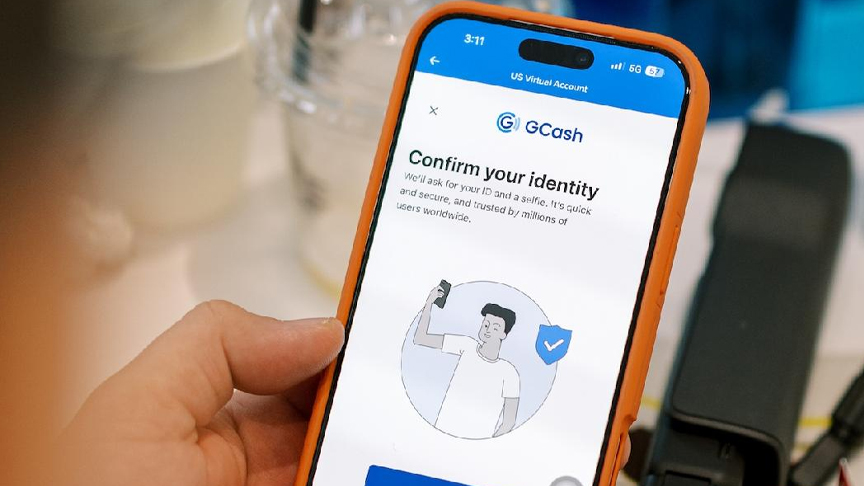
Create your Virtual US Account today
As freelancing continues to grow across the country, GCash hopes initiatives like the Freelancer Connect can help create more spaces where freelancers feel supported — not just financially, but as a community navigating a rapidly changing world of work together.
Creating your Virtual US Account is easy:
- Open the GCash app – Tap US Accounts in the Explore the App section
- Tap Continue and verify your information
- Complete your account creation
BizWiz
3 Lessons from women who successfully built careers in freelancing
Freelancers face inconsistent income, unpredictable clients, and little guidance on how to navigate it all. For longtime freelancers Mia Juan and Dana Novales, building a career online has meant learning these lessons in real time.
BizWiz
Focus on service: Lessons from Caltex station employees
All work—regardless of the profession or industry—serves a deeper purpose in society for as long as it is done with integrity and passion.

Toyota PH supports Tamaraw conservation in Mindoro, donates PHP3 million

Manulife expands financial literacy, clean water programs in PH

2GO mobilizes volunteers, supports nationwide coastal cleanup with logistics and supplies

Learning from 3 Filipino entrepreneurs who grew their negosyo

As local businesses grow, digital tools help stay flexible amid changing customer behavior

RENTAPASADA offers Filipino drivers a more accessible path to ride-hailing income

Many MSMEs remain vulnerable to disruptions beyond their control

Vietnamese food in San Pablo City’s Pho Viet Nam
Manulife expands financial literacy, clean water programs in PH
Learning from 3 Filipino entrepreneurs who grew their negosyo
As local businesses grow, digital tools help stay flexible amid changing customer behavior
RENTAPASADA offers Filipino drivers a more accessible path to ride-hailing income
Many MSMEs remain vulnerable to disruptions beyond their control
2GO mobilizes volunteers, supports nationwide coastal cleanup with logistics and supplies
Toyota PH supports Tamaraw conservation in Mindoro, donates PHP3 million

Biz strategy of Quento: Forget discrimination and capture as many as possible

FFTG as a must-visit cafe… and safe space in Quezon City

5 Video marketing tips

How to successfully market your biz as green

What to do before a ransomware attack

Smart advice to find success
-
 Ethical Biz2 weeks ago
Manulife expands financial literacy, clean water programs in PH
-
 BizWiz2 weeks ago
Learning from 3 Filipino entrepreneurs who grew their negosyo
-
 BizNews2 weeks ago
As local businesses grow, digital tools help stay flexible amid changing customer behavior
-
 BizNews2 weeks ago
RENTAPASADA offers Filipino drivers a more accessible path to ride-hailing income
-
 BizNews2 weeks ago
Many MSMEs remain vulnerable to disruptions beyond their control
-
 Ethical Biz2 weeks ago
2GO mobilizes volunteers, supports nationwide coastal cleanup with logistics and supplies
-
 Ethical Biz2 weeks ago
Toyota PH supports Tamaraw conservation in Mindoro, donates PHP3 million