Connect with us

BizListing

A Filipino family brand goes global through craft, customization and smart logistics

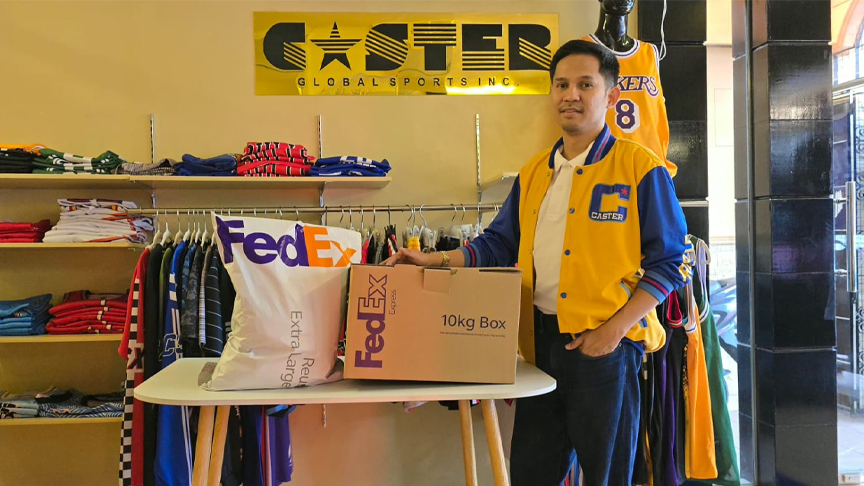
Founded in the early 1980s by Carlito Atienza, a master tailor in Metro Manila, Caster Sportswear began with a clear mission: to fill the gap for affordable yet high-quality customizable sportswear.

Published

on

In the dynamic world of sports apparel, success demands more than quality—it calls for vision, innovation, and the courage to push boundaries. These values have been at the heart of Caster Global Sports Inc.’s journey to becoming a trusted name in the industry.

Founded in the early 1980s by Carlito Atienza, a master tailor in Metro Manila, Caster Sportswear began with a clear mission: to fill the gap for affordable yet high-quality customizable sportswear. Carlito’s craftsmanship and commitment quickly earned the brand a reputation among discerning clients, including major banks and universities.

For decades, Caster thrived locally, but it was the fresh perspective of the second generation that unlocked its global potential—transforming a homegrown brand into an international player.

Going global

The turning point came with the next generation. Butch Atienza, vice president, Caster Global Sports, brought a global perspective from his experience at a multinational company. He saw that there was a growing demand overseas for the personalized kits his family has been producing for decades. At that time, Caster was well-known for making uniforms for local corporate clients. But expanding internationally meant rethinking logistics and embracing a bigger vision for growth.

Butch researched logistics providers and found FedEx. “We began shipping with FedEx in the early 2000s after finding the promotional box rates really attractive,” Butch shares. “Back then,we were sending five to nine packages a week, until a FedEx representative noticed our volume and visited us to open an account.”

This collaboration, now spanning more than 20 years, lowered the barrier to exporting and helped Caster Global test foreign markets without overcommitting resources. Shipments to the U.S. now take two to five days, shortening the feedback loop between customer and manufacturer.

Standing out in a crowded market

Caster’s competitive edge isn’t simply speed. In a market crowded with about 20 local competitors, the company leans into craftsmanship and customization for differentiation. While many suppliers focus on basic sublimated prints, Caster offers embroidery, tailored designs and one-off recreations. Customers can send a photo and receive bespoke sportswear. This service resonates with buyers in the U.S. and Europe who seek distinctiveness over off-the-rack sameness.

Behind the promise is a disciplined production process. Every order begins with a specifications sheet and sample production before mass rollout- a simple quality-control step that reduces costly mistakes. Investment in new equipment like full-body printers and modern embroidery machines , further improves consistency and throughput. Typical lead times range from two to three weeks for small runs (50–100 pieces) to three to six weeks for larger orders (around 1,000 pieces), allowing the company to serve both grassroots clubs and larger teams.

When errors occur, Caster communicates costs and options clearly, ensuring transparency to customers who have generally accepted the need to cover replacement shipping because of the service’s perceived value. This trust, coupled with responsive customer support, has turnedone-time orders into repeat business.

Scaling a manufacturing business means jugglingcash flow, balancing bespoke work with high volume production, and maintaining consistent quality as demand rises. These challenges shaped Caster’sstrategic decisions: standardizing specifications, documenting workflows, and partnering with a logistics provider that can scale with them.

Lessons from the past, and hopes for the future

Looking ahead, Butch is exploring international franchising and partnerships. Interest has come from clients in Australia, Malaysia, the United States and Switzerland, and the company is studying franchising models and assessing options. Locally, discussions have begun about sponsorships and collaborations with larger sports organizations, including talks around the Philippine Basketball Association.

For Philippine entrepreneurs watching from the sidelines, Butch’s advice is pragmatic: focus on product quality, invest in customer service, and build partnerships that reduce friction when expanding abroad. “Shipping reliably was a game-changer for us,” he says, noting that logistical confidence made it possible to sell beyond the Philippines without compromising service.

From Carlito Atienza’s vision in the 1980s to Butch’s global expansion in the 2000s, Caster Global Sports Inc. proves that Philippine craftsmanship, family values, and strong partnerships can push businesses to thrive in the global market. As they look to 2026 and beyond, this family business built on skills, quality, and innovation is only getting started.

Discover more inspiring stories from entrepreneurs across Asia Pacific on FedEx Business Insights.

BizListing

Claim to fame: Fried chicken built Lolo Claro’s

It claims to sell over 400 pieces of #friedchicken per day, so Lolo Claro’s must be good, no? We checked the former mami house turned restaurant in #Cavite during a quick #LGBT wandering.

Published

on

So… if a resto claims to sell as many as 400 fried chickens a day, you’re bound to think that what they have may be really good. So we checked Lolo Claro’s Restaurant in Cavite City, one of those restos that can claim that it was built by, yep, friend chicken.

How was Lolo Claro’s Restaurant for us?

@outragemag It claims to sell over 400 pcs of #friedchicken per day, so #LoloClaros in #Cavite must be good, no? We #LGBT checked this former #mami house turned #restaurant ♬ original sound – Outrage Magazine

Una, as background, this place is somewhat historical. Started over 25 years ago by Bernie Ilagan in honor of his late kutsero (horse carriage driver) grandfather, it used to just be a food stall that sold mami, among others, but eventually grew to have multiple branches.

Ikalawa, the branch we visited was easy to find, as it’s along a major road in Cavite City. Yeah, public transport passed the area. And there’s ample open-air parking for those with private vehicles.

Ikatlo, the resto is luma (antiquated). This should also serve as a warning since there, tabletops are peeling, corners are soiled, walls have who-knows-what prints, and so on. The squeamish may say it borders on… dirty, and they won’t be completely wrong.

Ika-apat, the staff was perfunctory – e.g. you have to pester them to clean a table for you, or follow-up an order, et cetera.

Ikalima, how were the offerings?

  1. Claro’s Fried Chicken (₱275 for half, ₱475 for whole) was similar to Max’s chicken – e.g. not that big and not over-fried, but not that tasty and quite dry.
  2. The chopsuey (₱290) was… peculiar. Think deconstructed, and you’d have an idea of their version – i.e. the veggies were steamed or boiled, and the sauce was just poured on top before serving. Good for those who just like steamed veggies; but for those who want chopsuey the traditional way, this isn’t gonna please you.
  3. The kare-kare (₱360) needed more oomph; kulang sa lasa. But at least you get enough laman, from the meat slices to the veggies. And yeah, the bagoong (shrimp paste) was good… even if they didn’t serve a lot.

Lolo Claro’s Restaurant was packed when we visited; we actually had to wait for a table to be vacated before we could eat. So this is a popular resto, indeed. I can’t, and won’t, justify this; to each his own. But we have reservations… with the venue, the staff, the food… And so off we go in search of more lafangan venues…

Lolo Claro’s Restaurant is located at Governor’s Drive corner Naic Indang Road, Cavite City.

Continue Reading

BizListing

From coffee to rice meals: The Foam Coffee business model

The search for a good cup of coffee is what led us to Foam Coffee, which – it must be pointed out – is more of a resto than a café.

Published

on

Baguio City has always been a must-visit place for foodies, thanks to the many culinary offerings from the Cordillera region (think pinikpikan, etag and binaod, among others). But – whether you agree with us or not, particularly since you may know some venues we don’t – one of the biggest challenges we encountered was looking for good kape.

The search for a good cup of coffee is what led us to Foam Coffee, which – it must be pointed out – is more of a resto than a café.

So, how was our visit to Foam Coffee?

@outragemag Looking for #kape in #FoamCoffee in #Baguio, only to end up eating not-cheap #ricemeals ♬ original sound – Outrage Magazine

Una, this is easy to locate, as it’s right across the city hall of Baguio.

Ikalawa, the place itself is sterile-looking. Yep, maaliwalas siya (it’s airy), newly-furnished, is clean, and so on. But when we were there, it also felt quite impersonal, and didn’t feel like a community café or something.

Ikatlo, this is a self-service and CLAYGO (clean as you go) venue. Meaning, you won’t really engage with the staff as they’re there just to take and then give you your order, and then clean up after you if you failed to follow the CLAYGO policy. This adds to the making of this place as impersonal.

And ika-apat, how were the offerings?

So… the original intent was to grab coffee since this was repeatedly highly ranked by reviewers. Alas, the ₱120 Americano was, to start, not even that warm anymore when served. And taste-wise, it was almost like it was watered down.

The rice meals that we ended up also trying were actually not bad. The ₱230 Orange Chicken (orange-glazed chicken with rice) tasted… orangey, sweetish and yet citrusy. The ₱270 Bulgogi Tapa (thinly sliced Korean beef that’s marinated in sweet and salty soy in garlic butter, with rice and eggs), meanwhile, was sweet and savory. The rice in both dishes was good, too; flavorful so that even sans the toppings, already a meal.

For us, if there’s one issue with the rice meals, it’s the size of the servings. Particularly the ulam (viand). You will not get a lot. Which, for us, makes this place a somewhat pricey silog-like venue.

Foam Coffee has a market – e.g. check those who study while there. This is understandable even with the place’s limits. But we’re off elsewhere… perhaps in search of good coffee, as businesses should have if they use the word in their business name.

So off we go in search of more lafangan venues…

Foam Coffee is located at Upper G/F Travelite Hotel, Shuntug St., Baguio City. For more information, contact 0977 602 3750.

Continue Reading

BizListing

Following the footsteps of coffee chains as a biz model for Baguio City’s Rebel Bakehouse?

When you check lists of places for foodies, many of the same venues are mentioned… and one of those is Rebel Bakehouse. We checked the food biz.

Published

on

Baguio City has become a must-visit location for those looking for good – or at least well-promoted – restaurants. But we noted that when you check lists of places for foodies, many of the same venues are mentioned… and one of those is Rebel Bakehouse.

We checked the branch right beside the Baguio Cathedral of Our Lady of Atonement, and… how was it for us?

@outragemag #LGBT checking #RebelBakehouse in #Baguio to ascertain if it's a good alternative to #starbucks, #CBTL ♬ original sound – Outrage Magazine

Una, the place is tricky to find… at least for non-churchgoers. We actually thought it’s in some street parallel to the church; instead, it’s actually right inside the church’s compound.

Ikalawa, if there’s a word to describe the venue, it’s maaliwalas (airy). The venue is divided into spots – e.g. there’s the upper floor, the inside, and the seats outside. Since Baguio City can still get cool, or even cold, open-air din siya, though this also means that flies from outside can (and do) enter the premises.

Ikatlo, the workers are chill. If asked, they can elaborate on what’s being offered; otherwise, if you don’t engage with them, they’re typical café staff… there but not there.

Ika-apat, how was the food? TBH, since we just came from a heavy meal, we just tried some of their breads and drinks.

  1. The Classic Pain Au Chocolat (₱150) and the Cinnamon Bun (₱180) looked pretty, easily reminding me, personally, of breads in some bakery in Paris. But… taste-wise, they’re not remarkable. We’d go as far as saying that they both tasted the same… just like croissant. The dark chocolate inside the former was, at least, good; but the cinnamon was not even apparent in the latter.
  2. The kape (₱110), served black, was so-so. I – sadly – really can’t even remember drinking it.

We’re not sure the way to beat Starbucks or Coffee Bean & Tea Leaf is to mimic them. Which is how being in Rebel Bakehouse felt like; as if we were in one of the international coffee chains’ branches in Tagaytay. This isn’t to say this is bad… even considering our misgivings with the breads and kape. After all, this is still an okay, and local, option.

Perhaps if we visit again, if at all, we’d try their meals na. But until then, join us as we look for more lafangan venues…

Rebel Bakehouse is located right beside the Baguio Cathedral of Our Lady of Atonement, at CH6X+WM4, Upper Bonifacio St., Baguio City.

Continue Reading
Advertisement
Advertisement

Like us on Facebook

Trending