
Connect with us

BizNews

3 Filipino MSME owners share how to enter your easy era of business

When presented with the opportunity to use solutions, more business owners are discovering the advantages of adopting new tech innovations — especially when it comes to payments.

Published

on

Many of today’s MSMEs are born from a passion: a recipe that’s been passed down for generations, a love of coffee and pastries, or a vision to showcase local fashion and design to the global stage. But turning that passion into a sustainable business is another thing on its own. Day-to-day challenges like managing orders and keeping payments on track can be overwhelming.

As businesses grow, so does the need for better tools. While there’s no shortage of tech in the market, many MSMEs often steer away due to cost and complexity. However, when presented with the opportunity to use solutions from GCash for Business, more business owners are discovering the advantages of adopting new tech innovations — especially when it comes to payments.

One innovation is GCash SoundPay. This device provides instant voice confirmation for every successful QR payment made. It’s easy to carry, affordable, and simple to use – requiring only a fully verified GCash account of at least 12 months to get started.

For Nikko Mendoza of Smthn Smthn Cafe in Davao, Michael Chan of Mom Rose Chicken Lechon in Bacolod, and Emgee Po of Get Spotted in Bacolod, embracing digital tools has helped them grow their brands while allowing them to enter a new era of ease.

Here’s what they’ve learned:

1. Faster checkouts make everyday transactions feel hassle-free Michael Chan, Mom Rose Chicken Lechon

Mom Rose Chicken Lechon was born from both necessity and memory. When the pandemic shut down their carinderia in 2021, the Chan family shifted to making their signature Spicy Chicken Lechon, a dish inspired by their late mother, Rosemarie.

To this day, the business honors her wish for “a happy family,” and GCash SoundPay helps them keep that promise by ensuring this joy extends to their customers by making everyday payments stress-free.

“Most of our customers prefer GCash now. With GCash SoundPay, payments are faster and more reliable, so we can focus on serving food that makes people happy,” Michael shares.

In store, each team member carries their own GCash SoundPay device, worn with a lanyard and ready to use. This allows them to accept and confirm payments anytime, anywhere. No need for long waiting lines and just one payment acceptance device at the counter. Because of the real-time audio alerts, transactions move quicker, and the team can focus fully on serving their customers more efficiently.

2. Tech is a driver of growth. – Emgee Po, EMGEE by Get Spotted

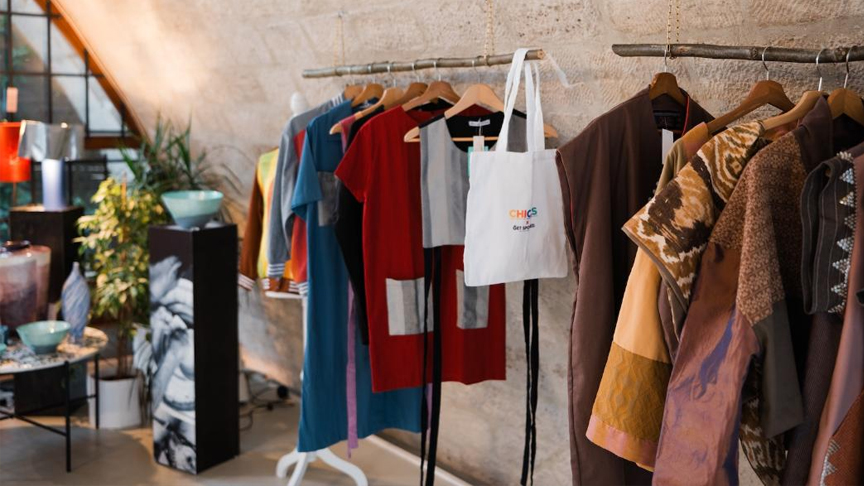
A thesis project in 2011, EMGEE by Get Spotted is a local fashion brand from Bacolod that is now making waves internationally. Its founder, Emgee Po, partners with Negros weavers and Angono seamstresses to create one-off designs that are proudly Filipino. From a mall location in Ayala Malls Capitol Central to pop-ups in Paris and soon New York, EMGEE continues to expand its reach.

GCash played a role in how Emgee connected with customers. She first used her personal GCash account for payments, where cashless transactions made it easier to keep up with multiple customers paying at the same time.

“Most [of] our sales for the shop would be [through] credit cards and GCash. It’s very easy and it’s very convenient [to go cashless],” Emgee shares. But as the business grew, the confusion of mixing personal and business transactions and manually checking her phones to confirm payments started becoming a challenge.

That’s why she moved to GCash for Business. With GCash for Business, she now has everything to confidently grow her business such as an easy-to-use business wallet, no limits, no transaction fees. Now, there’s no more mixing personal and business payments.

3. Businesses benefit from an easy-to-use platform  – Nikko Mendoza, Smthn Smthn Cafe

What started as seasonal pastries grew into a full-fledged garden café in 2024. Since day one, Smthn Smthn Cafe in Davao has accepted GCash payments to serve its customers better. But as the café expanded, owner Nikko Mendoza realized he needed more than just a way to receive payments.

With the new GCash for Business Portal, businesses get access to an easy-to-use platform to track and manage all online transactions in one place. It includes a simple, , easy-to-use payments tracker and management system, no wallet limit when receiving cashless payments from customers, and no transaction fees when paying suppliers through GCash. Additionally, the portal allows merchants to pay their suppliers directly through bank transfer or even to their GCash accounts with no fees, reducing the need to use multiple platforms and pay multiple fees.

For Nikko and his team, utilizing a system like the GCash for Business Portal means more time to focus on running the café, and less time worrying about payment limits, fees, or keeping track of scattered transactions.

Tech Made for Business’ Easy Era

From Manila to Bacolod to Davao, these small business owners show how digital solutions are helping them experience ease everyday in their operations. With GCash SoundPay and an upcoming new device that enables merchants to accept credit card payments through their phone, GCash for Business continues to provide MSMEs a selection of tools tailored to their specific needs per industry.

Utilizing these solutions also comes with a dedicated business account in the new GCash for Business Portal, providing a dedicated dashboard where business owners can order devices and manage their business transactions in a simple, easy-to-use business portal with no limits and no fees.

Learn more about how GCash for Business can empower your business and sign up today with just a GCash verified account of at least 12 months.

BizNews

Wine sellers, pay attention: Women more likely to choose wine from female winemakers

Messages like “proudly made by a woman winemaker” increased women’s intentions of purchasing wines, particularly when the label’s artwork reinforced the point with feminine gender cues such as flowers. Women were also willing to pay higher prices for those wines.

Published

on

Promoting women’s ownership in wineries can boost sales among the largest group of wine consumers, who happen to be women.

Messages like “proudly made by a woman winemaker” increased women’s intentions of purchasing wines, particularly when the label’s artwork reinforced the point with feminine gender cues such as flowers. Women were also willing to pay higher prices for those wines, according to the research from Washington State University and Auburn University.

The findings are noteworthy because 59% of all wine purchases in the US are made by women, said Christina Chi, coauthor of the research and professor of hospitality business management at WSU’s Carson College of Business.

Wine is often considered a cultural product, where the winemaker’s identity plays a role in shaping the brand’s image, she said.

Women winemakers, however, are less likely than their male counterparts to include their names on bottle labels or draw attention to their gender. Their reluctance may stem from concerns about prejudice toward their products in the male-dominated wine industry, Chi said.

“Our findings suggest that women winemakers and winery owners can benefit by being more visible,” she said. “The research shows that they can disclose their ownership with confidence and leverage it as a marketing strategy.”

The possibilities include putting “women-made wine” statements on labels or packaging, and retail store displays featuring women-made wines.

Demi Deng, an assistant professor at Auburn who earned her doctorate at WSU, is the first author on the research published in International Journal of Hospitality Management. Ruiying Cai, an assistant professor of hospitality business management at WSU, also contributed.

The new findings build on earlier studies showing that women are more inclined to buy wine with feminine gender cues on the labels. The 2024 research – by Cai, Chi, Deng, and WSU Emeritus Professor Robert Harrington – received widespread publicity. Beverage trade journals carried the story, and women winemakers were enthusiastic about the findings.

“As researchers, we want our work not only to have societal impact, but to have practical significance for the wine industry,” Chi said. “From the response, we saw that women winemakers were following our research and were eager for additional studies about women wine consumers.”

More than 1,000 US women participated in the most recent research, which involved a three-part study.

First, the researchers replicated the 2024 findings about feminine cues on wine labels. Using a fictitious Columbia Valley red table wine, the women surveyed expressed higher intentions of purchasing the wine when the label’s artwork featured a bouquet of flowers versus a masculine portrait. They were also willing to pay $3.50 more per bottle – about $17.75 for wines with feminine labels compared to $14.25 for wines with masculine cues.

In the second phase of the study, a “woman-made wine” statement was added to marketing materials. Women consumers had even stronger purchase intentions for wines with both the statement and feminine artwork on labels, the research found.

In the final phase, photos of women winemakers were further added to the marketing materials. But women were less likely to buy feminine-label wines when the female winemakers were pictured. Rather than focusing on the “woman-made” messaging, consumers’ decisions may have been swayed by whether they related to the individual women portrayed in the photographs, researchers said.

The studies also tested the marketing strategies on wines with masculine labels. Adding a “woman-made” statement significantly increased their appeal to women consumers. And when female winemakers were pictured in the marketing materials, women were willing to pay $3 more per bottle for wines with masculine labels.  

Besides helping women winemakers market their products, Deng said she hopes the research will draw attention to women’s contributions to the industry. In the United States, about 18% of winemakers are women.  

Deng worked as a sommelier in New Zealand before she earned her doctorate. “I actually encountered a lot of women winemakers, but their names aren’t visible in the wine market,” she said.

Continue Reading

BizNews

Want entrepreneurs to work harder? Tell them they’ll fail

Most entrepreneurs – people who start their own businesses – actually identify with the business they’re running. So being told that your business, your idea that you are committed to, will be a failure can almost seem like a personal attack.

Published

on

A new study finds entrepreneurs become more committed to their business ventures when they are told they will fail, increasing their efforts to make those businesses successful.

“Most entrepreneurs – people who start their own businesses – actually identify with the business they’re running,” says Tim Michaelis, corresponding author of a paper on the work and an assistant professor of psychology at North Carolina State University. “So being told that your business, your idea that you are committed to, will be a failure can almost seem like a personal attack.”

“We wanted to see if being told that their business will fail actually gets entrepreneurs to commit even more deeply,” Michaelis says. “We were somewhat surprised that researchers had not already examined this. Most of the literature in this area is from the field of developmental psychology and hadn’t explored potential business implications. Fundamentally, we wanted to know if having an underdog mentality can motivate entrepreneurs.”

To explore the subject, the researchers conducted three studies.

For the first study, the researchers recruited 423 entrepreneurs; of those, 213 were in a control group that was not asked about a time they had been told they would fail. One hundred and seven participants were asked about, but could not recall, a time they were told they would fail. The remaining 103 participants did recall a time they were told they would fail. The researchers then asked all study participants questions designed to capture how committed they were to persisting with their new businesses.

“We found that entrepreneurs who could recall being told their business would fail displayed a deeper commitment to persisting with their business ventures,” Michaelis says.

For the second study, the researchers worked with 579 entrepreneurs. In this study, the control group consisted of 289 participants; 234 participants couldn’t remember being told they would fail; and 56 could recall a time they were told they would fail.

This time the researchers essentially replicated the first study, but rather than asking questions designed to measure persistence, they asked questions designed to measure the extent to which study participants were motivated to prove someone wrong. The 56 participants who could recall being told they would fail were asked about their motivation to prove that specific naysayer wrong – the so-called “underdog effect.” The remaining study participants were simply asked about their motivation to prove something to general stakeholders.

“The results here were consistent with the first study – recalling a time when someone told them they would fail led to increased motivation to persist with their business venture,” says Michaelis.

For study three, the researchers recruited 417 entrepreneurs. The study participants were surveyed once per month for three months. The first month’s survey served to establish a baseline, measuring the extent to which each study participant was motivated to persist with their venture by the underdog effect – a desire to prove any doubters wrong.

The second and third surveys varied slightly, but were essentially designed to assess the extent to which motivation and persistence were driven by the underdog effect. The surveys also accounted for other variables associated with motivation and persistence, such as confidence, past experience, financial benefit and passion for the work.

“The third study reinforced what we found in studies one and two – the underdog effect is a powerful motivator that increases an entrepreneur’s motivation and persistence regarding their venture,” says Michaelis. “In other words, the underdog effect leads to people working harder, focusing on their venture, and really committing to the success of their business.”

But the studies also revealed something unexpected.

“There were a surprisingly large number of study participants who had never been told that they would fail – they had only ever received positive feedback, or possibly no feedback, about their business ideas,” says Michaelis. “And we found that those study participants were less committed to their business ideas and had lower levels of persistence.

“This work offers real insight into what motivates entrepreneurs, and it raises some interesting questions,” says Michaelis.

“How do you give entrepreneurs enough support to encourage their initiative, but enough resistance to help them develop the drive they need to succeed? How can we train entrepreneurs to distinguish between doubts that can serve as motivational fuel and constructive criticism that highlights real flaws in a business plan? These are issues we can explore moving forward.”

The paper, “I’ll prove you wrong! The underdog effect as an antecedent to entrepreneurial action and venture persistence,” is published in the Journal of Business Venturing. The paper was co-authored by Jeffrey Pollack, the Lynn T. Clark II Distinguished Professor of Entrepreneurship in NC State’s Poole College of Management; Jon Carr, the Jenkins Distinguished Professor of Entrepreneurship in NC State’s Poole College of Management; April Spivack of the Hanken School of Economics in Finland; Nicholas Smith of Northern Illinois University; and Alexander McKelvie of Syracuse University.

Continue Reading

BizNews

Study shows scaling startups risk increasing gender gaps

Founders with HR‑related education counteract these challenges. In ventures led by founders with HR training, the odds of hiring a woman increase by more than 30 percent, and the odds of appointing a woman to a managerial role increase by 14 percent for the same level of scaling.  

Published

on

When startups scale quickly, founders often make hurried hiring decisions that unintentionally disadvantage women, according to new study from the Stockholm School of Economics in Sweden. The study shows how the pressures of rapid growth increase the likelihood that founders rely on mental shortcuts and make biased decisions. 

Drawing on large‑scale Swedish data, the study shows that scaling—when companies hire far more people than their usual growth trend would predict—puts pressure on founders to decide swiftly, which increases the use of mental shortcuts. These shortcuts can activate gender stereotypes, shaping who gets hired and who moves into managerial roles.  

“During those moments of rapid growth, even well‑intentioned leaders can fall back on familiar stereotypes when assessing who they believe is best suited for the role,” says Mohamed Genedy, co-author and Postdoctoral Fellow at the House of Innovation, Stockholm School of Economics. 

Reduced odds of hiring female managers 

His research analyzes more than 31,000 new ventures founded in Sweden between 2004 and 2018. It finds that in male‑led startups, scaling reduces the odds of hiring a woman by about 18 percent, and the odds of appointing a woman to a managerial position by 22 percent.  

These patterns emerge even in a highly gender‑equal national context, making the findings especially noteworthy.  

Crucially, the study reveals that founders with HR‑related education counteract these challenges. In ventures led by founders with HR training, the odds of hiring a woman increase by more than 30 percent, and the odds of appointing a woman to a managerial role increase by 14 percent for the same level of scaling.  

“When founders have experience with structured hiring practices, the gender gaps shrink, and in some cases even reverse,” Genedy says.  

“This shows that getting the basics of HR right early on really pays off. When things start moving fast, founders with HR knowledge are less likely to rely on biased instincts and more likely to hire from a broader talent pool.”  

Prior experience in companies with established HR practices also helps, though less so. It raises the likelihood of hiring women as the new ventures scale, but does not significantly affect managerial appointments. 

Differences persist in female-led ventures 

The study additionally shows that these patterns are not driven by founder gender alone. Even solo female‑led ventures display similar tendencies when scaling, though to a somewhat lesser degree.  

And in female‑dominated industries, scaling increases the hiring of women for regular roles but still reduces the likelihood that women are appointed into managerial positions.  

“When scaling accelerates, cognitive bias kicks in for everyone,” says Mohamed Genedy. “Female founders are not immune to these patterns.”  

Together, these results point to underlying cognitive mechanisms that shape decisions under time pressure.

The study, Scaling with Bias? The role of founders’ HR knowledge and experience in hiring and managerial appointments, was published in Human Resource Management.

Continue Reading
Advertisement
Advertisement

Like us on Facebook

Trending