Connect with us

BizNews

Many MSMEs remain vulnerable to disruptions beyond their control

Years of hard work can be compromised in a matter of hours by natural disasters that the country regularly experiences, due to its location along the Pacific Ring of Fire and within the typhoon belt.


Published

on

Often regarded as the backbone of the Philippine economy, the country dedicates the month of July in recognition and celebration of micro, small, and medium enterprises (MSME). According to the Department of Trade and Industry, MSMEs account for 99% of businesses nationwide and provide employment to nearly 65% of the country’s workforce.

Yet despite their vital role, many MSMEs remain vulnerable to disruptions beyond their control, from rising costs and cash flow pressures to other unforeseen events that can threaten business continuity. Years of hard work can be compromised in a matter of hours by natural disasters that the country regularly experiences, due to its location along the Pacific Ring of Fire and within the typhoon belt. For entrepreneurs, being prepared goes beyond simply protecting physical assets; it is ensuring they can continue supporting the people and communities who rely on them.

When unexpected setbacks occur, it is never only the business owner who feels the impact. Every closed storefront, delayed operation, or damaged workplace can also affect the people whose livelihoods rely on it. Protecting a business is more than safeguarding an investment; it is also protecting the dreams, stability, and future of everyone who relies on it to keep running.

This message comes to life in the latest and last film of AXA Philippines’ Everyday Protectors campaign, which follows Lucing, a bakery owner whose shop is damaged by a powerful typhoon. As heavy rain continues to pour, Lucing and her staff choose to keep distributing bread to people in their neighborhood who need it most, demonstrating that for many entrepreneurs, being there for their community is important, especially during crises.

The film ends with Lucing’s bakery reopening under clearer skies, a hopeful reminder that businesses can recover when they are prepared for the unexpected. That readiness is especially important in a country where severe calamities can force businesses to close permanently. According to the Philippine Institute for Development Studies, around 25% of SMEs are unable to reopen. For Lucing, however, the storm did not mark the end of her story as she was equipped with advanced protection that enabled her to begin again and continue supporting the people who depend on her business.

Lucing’s story reflects the kind of risk that many Filipino entrepreneurs face and the role protection can play in helping them recover. Through MSME Secure, AXA helps business owners recover from unforeseen events so they can move forward with greater confidence. In addition to coverage for property damage and spoiled inventory caused by fire, typhoons, floods, and other covered calamities, MSME Secure provides protection against risks such as burglary, employee fraud, and the loss of business funds due to theft or robbery—whether outside the premises, in transit, or in the custody of staff or messengers. It also helps with legal liabilities and related expenses arising from incidents involving customers or other third parties.

Recognizing that businesses have different needs and budgets, AXA also offers MSME Secure Lite for basic protection and MSME Secure Max for more comprehensive coverage, allowing entrepreneurs to choose the level of protection that best fits their business.

By helping businesses bounce back after unexpected disruptions, AXA enables entrepreneurs to focus not only on rebuilding what was lost, but also on continuing to create opportunities, support livelihoods, and serve the communities that count on them.

As the one name to cover all your insurance needs, discover how AXA can provide complete protection for small and medium businesses, health, car, and travel here.

BizNews

Tip for resto owners and managers: Plating matters, and how sauce placement can make a dish appear healthier

The way food is presented can shape diners’ expectations before they even taste it.
Published

on

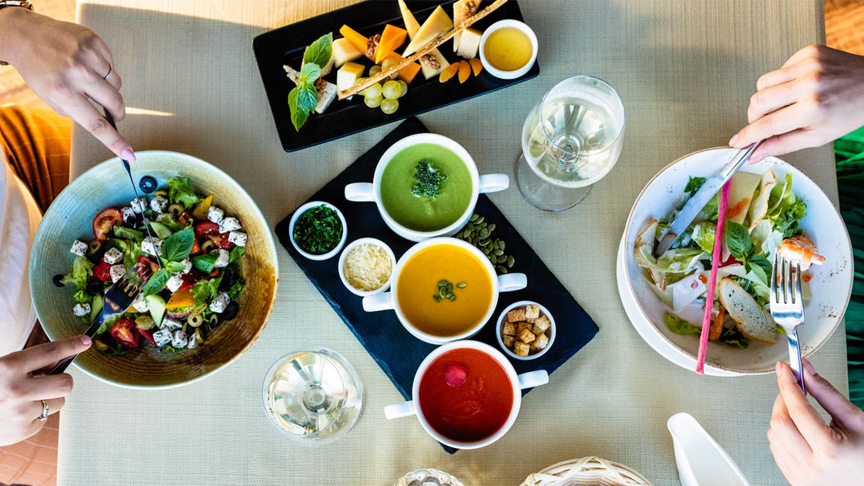
Our experience of eating is shaped by the combined influence of vision, smell, touch, and taste. The way food is presented can shape diners’ expectations before they even taste it. Visual features, such as arrangement and esthetic design, can influence perceptions of taste, quality, healthiness, and overall appeal.

Although previous studies have examined factors such as plate size, arrangement, and neatness, relatively little attention has been given to sauce presentation. Sauces can serve as both flavor additions and visual elements, and their placement may shape how diners perceive and interact with a dish.

To investigate these effects, researchers led by Dr. Kosuke Motoki of the Faculty of Business and Commerce, Keio University, Japan, examined how chef-designed sauce presentations influence consumers’ evaluations of a dish. The research was conducted in collaboration with Dr. Kohei Yamaguchi and Dr. Haruka Tohara of the Department of Dysphagia Rehabilitation, Institute of Science Tokyo, Japan, and Dr. Shin-ichi Ishikawa of the Department of Food Science and Business, Miyagi University, Japan, along with Chef Tatsuya Noda of the PLUM KNOT Co., Ltd., Japan. Their findings were published in Volume 15, Issue 17 of the journal Foods.

The idea for the study grew from discussions among Dr. Motoki, Dr. Yamaguchi, Dr. Ishikawa, and Chef Noda about food artistry and plating at 8go, the restaurant at Gastronomy Innovation Campus Tokyo (GIC Tokyo), where the study was later conducted. GIC Tokyo, developed in partnership with Tokyo Tatemono Co., Ltd., provides a collaborative setting for researchers, chefs, and industry partners.

“Our study involved 57 participants in a real restaurant setting at 8go, where we evaluated the same sturgeon-fritter dish presented with two different sauce arrangements. Sturgeon aquaculture is primarily oriented toward caviar production, while sturgeon meat is less commercially prominent. Its fuller use may improve resource efficiency, placing the study in a sustainability-oriented culinary context,” explains Dr. Motoki.

Participants evaluated a sturgeon-filet dish in two ways. In the minimal plating condition, sauces were placed separately on the plate, while in the drizzle presentation condition, sauces were distributed across the plate and around the food. Each participant experienced both versions, allowing the researchers to compare individual responses. The dish was prepared in collaboration with a professional chef from a restaurant recognized with a Michelin Green Star.

Before tasting, participants rated various measures including expected tastiness, perceived healthiness, intention to eat, overall liking, perceived artistic presentation, and willingness to pay. Minimal plating produced a significantly higher perceived healthiness rating than drizzle presentation: 4.65/7 compared with 4.05/7. This difference remained significant after correction for multiple comparisons.

“We observed that minimal plating made the same dish appear healthier, showing how small visual details can influence our first impressions of the food,” notes Dr. Motoki.

No significant differences were found in the other pre-tasting measures. After tasting, minimal presentation received higher ratings for overall liking and intention to eat more, but these differences did not remain significant after correction for multiple comparisons and were therefore considered preliminary.

One possible explanation for the pre-consumption healthiness finding could be visual simplicity. The minimal presentation may appear less visually dense, potentially associating it with qualities such as simplicity or naturalness.

Additionally, separately placed sauces may also give diners greater control over how much sauce they use, which could influence the eating experience. However, these mechanisms were not directly measured.

The findings offer a practical direction for evidence-based food presentation in restaurants and hospitality. “By bringing together researchers, a professional chef, and 8go as a real-world research setting within GIC Tokyo, we were able to examine how chef-designed plating shapes diners’ evaluations before and after tasting,” says Dr. Motoki. These findings show that sauce placement can help communicate a healthier impression. The preliminary post-tasting results also provide a starting point for investigating whether presentation and the way diners use the sauce may influence enjoyment.

Importantly, the researchers emphasize that looking healthier does not necessarily mean being nutritionally healthier. Further studies across different foods, plating styles, and dining environments are needed to gain deeper insights.

Continue Reading

BizNews

Autonomy, purpose and personal control associated with entrepreneurship may outweigh its well-known stress and pressures

Creating a more entrepreneurial workplace, where employees have the freedom to make decisions, pursue ideas and see the results of their efforts, may help support engagement and well-being while avoiding some of the financial and personal risks associated with starting a business.

Published

on

Conventional wisdom suggests that the long hours and pressures of entrepreneurship can take a toll on health. But new research by Cristiano Bellavitis, associate professor in the School of Business at Stevens Institute of Technology, and his collaborators, finds that entrepreneurs tend to live longer than people who spend their careers working for others.

Drawing on more than two decades of data from over 27,000 Americans aged 50 and older, Bellavitis’s study finds that people who have engaged in entrepreneurship have approximately a 10 percent lower risk of death than non-entrepreneurs, even after accounting for factors like age, income, education and health. 

Researchers suggest that the autonomy, purpose and personal control associated with entrepreneurship may help explain the pattern and contribute to long-term well-being. 

“Most people think of entrepreneurship as extremely stressful, and it certainly can be,” Bellavitis says. “But entrepreneurship also gives people a high degree of autonomy and the opportunity to pursue something they genuinely love or care about. Our findings suggest those benefits may have lasting effects.”

Mental health appeared to be a statistically significant factor, Bellavitis notes. Entrepreneurs reported lower levels of depression and loneliness, both of which have been associated with better health outcomes and greater longevity.

The study found that the longevity advantage was the strongest among opportunity-driven entrepreneurs: individuals who launched their ventures because they wanted to start a business and pursue a promising opportunity. By contrast, people who became entrepreneurs out of necessity, such as after losing a job, did not reap the same benefits.

“What seems to matter is not entrepreneurship alone, but the circumstances under which people enter it,” Bellavitis says. “When entrepreneurship reflects greater choice and opportunity, the autonomy and sense of purpose that can come with it may provide psychological benefits that extend beyond financial rewards.”

The study titled Do Entrepreneurs Live Longer? was published in the Journal of Business Venturing on October 22, 2026. 

The researchers emphasize that while the study identifies a strong relationship between entrepreneurship and longevity, it does not prove that entrepreneurship directly causes people to live longer. However, even after controlling for numerous demographic, economic and health factors and conducting additional analysis, the relationship remains significant.

Researchers also found that longer and more frequent engagement in entrepreneurship was associated with a longer lifespan.

The findings don’t apply to entrepreneurs only, Bellavitis notes — employers can learn from them as well. Organizations can incorporate some of entrepreneurship’s benefits by giving employees greater autonomy, ownership and visibility into the impact of their work.

Creating a more entrepreneurial workplace, where employees have the freedom to make decisions, pursue ideas and see the results of their efforts, may help support engagement and well-being while avoiding some of the financial and personal risks associated with starting a business.

“In many ways, that could be the best of both worlds. Companies can foster the independence, purpose and excitement that often come with entrepreneurship while providing the stability of traditional employment,” Bellavitis says. 

He adds that “the broader lesson isn’t that everyone should quit their job and start a company.” It’s that purpose, autonomy and meaningful engagement matter. “Whether you’re an entrepreneur or an employee, finding ways to have ownership of your work and a reason to be excited about what you do every day is important for long-term well-being.”

Continue Reading

BizNews

From click to doorstep: The hidden decisions behind e-commerce orders

Every time a shopper clicks “Place Order,” a complex process begins behind the scenes. An online retailer must decide where each item should be fulfilled, how orders should be picked and packed, how parcels should be transported, and how returns should be handled.

Published

on

Every time a shopper clicks “Place Order,” a complex process begins behind the scenes. An online retailer must decide where each item should be fulfilled, how orders should be picked and packed, how parcels should be transported, and how returns should be handled. These decisions are tightly connected: a choice made at the start can affect costs, workload, delivery speed and customer experience downstream.

In a study published in the Journal of Management Science and Engineering, Yuankai Zhang, Wei-Hua Lin, Qiong Tian and Xiangpei Hu reviewed the growing body of research on B2C online order fulfillment, including emerging omni-channel models in which physical stores can also serve as fulfillment locations.

For managers, the review provides a practical way to look beyond individual warehouse or delivery decisions and consider the entire fulfillment chain. For researchers, it identifies future directions including better coordination across stages, decision-making under uncertainty, sustainability, behavioral analytics, and the integration of artificial intelligence (AI) with digital twins and optimization.

The research papers included were published between 2007 to May 2026. The systematic search began with 1,495 records and resulted in 198 articles for detailed analysis. The authors organized the literature around the real-world fulfillment process: order assignment, warehouse operations, shipping and delivery, and return operations.

The review highlights four characteristics that make B2C fulfillment especially challenging: very large product assortments, networks with multiple fulfillment locations, personalized multi-item orders, and tight delivery time windows. It also shows how research is increasingly moving beyond isolated decisions and static planning toward more integrated and real-time approaches.

“B2C order fulfillment is not a collection of separate tasks. Decisions made at one stage can create consequences at another,” says Zhang. “By viewing the process as a connected system, we can better identify where coordination, data and new technologies can improve fulfillment decisions.”

The team also examined how data analytics, AI and emerging generative AI can support forecasting, scenario generation and operational decision-making. “Rather than replacing optimization methods, these technologies are increasingly viewed as decision-support tools that can work alongside optimization,” adds Zhang.

Continue Reading
Advertisement
Advertisement

Like us on Facebook

Trending